
In two previous posts, I’ve looked at time served from the perspective of admissions and release cohorts. In both cases, the story is one of violence. When we look at those admitted from 2000 onwards, almost all those who end up serving long terms had been convicted of a violent crime. And if we look at those released in the 2000s (and thus sentenced in 1990s or 1980s), again: almost all those serving long terms were convicted of violence.
But that does leave one potential gap: what if sentences for crimes like drugs were really, really long back in the 1980s and 1990s? We wouldn’t see those people in the admissions data (since that starts in 2000), nor would we see them in the release data (since they are still in prison). Maybe there’s a huge number of people still serving for non-violent crimes. It’s a fair question to ask!
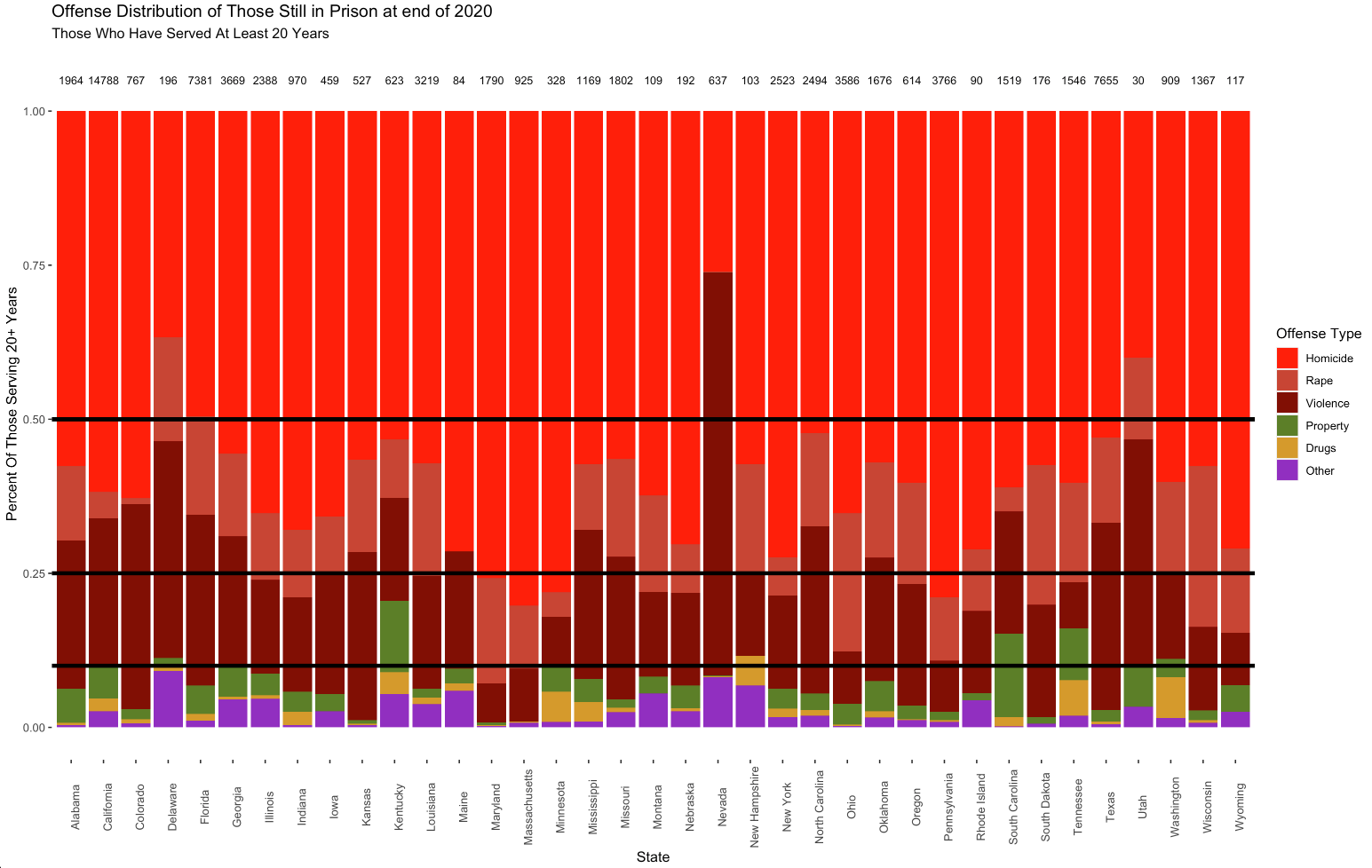
But the answer is clear: that population does not exist. If we look at those who are still in prison at the end of 2020 (the last year for which I have data) and have served at least twenty or thirty, years, well over 90% are serving time for a crime of violence across all the states in my data (which come to 37, including the 9 largest states, which alone are home to ~45% of the US population).
Here are how things look for those who have served at least 20 years (with the total number of such people at the top of each column):
And here is how things look if we zoom in on those who have served at least 30 years (who are also included in the 20+ graph above):
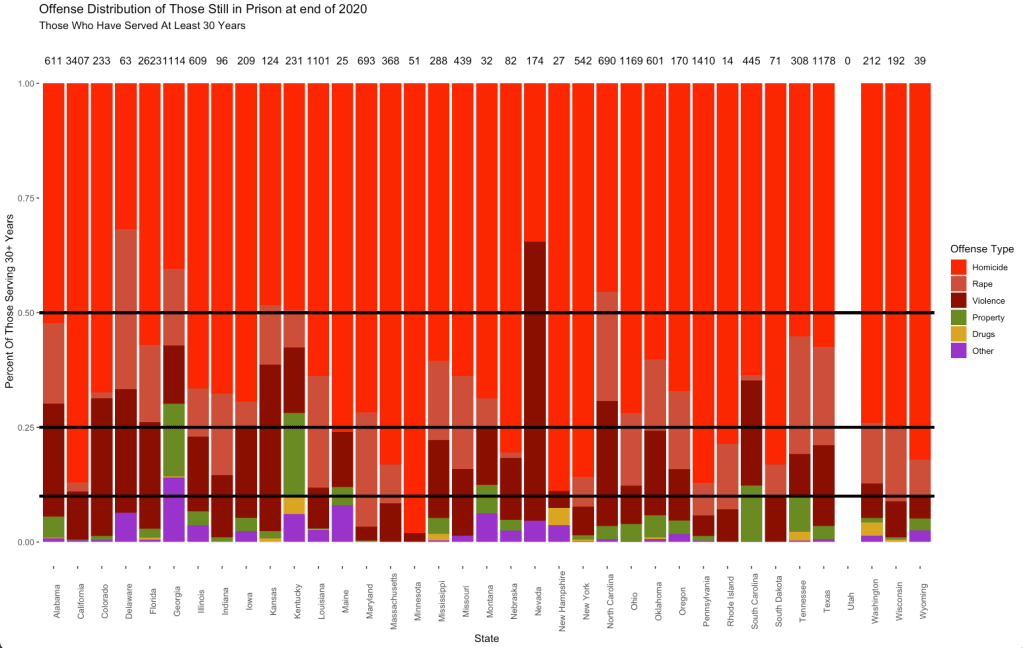
What definitely stands about, besides the central role of violence., is the distinct role not played by drug convictions. In only two states–Tennessee and Washington–does drug’s share of those who have served at least 20 years even come close to 10% (the lowest of the three black lines), and in no state does drug’s share of those serving 30 or more even exceed 5%.
This is even true in states like Louisiana, whose population of people serving long sentences for drugs often gets extensive media attention. Of course, it’s worth noting that the size of Louisiana’s over-30-year population (1,101) is on a par with states like Georgia (1,114) whose population is more than double Louisiana’s, and only half that of Florida (2,623), whose population is nearly five times that of Louisiana’s. So drug’s share is small percentage of what is a shockingly large absolute number. Louisiana is a harsh state, and on a comparative basis likely has a lot of people serving long sentences for drugs. But even Louisiana’s long-serving population is almost entirely serving time for violence–in fact, over 50% are in just for homicide, and nearly 90% just for homicide or rape.
Now, as always, I feel the need to conclude by stressing that showing most people serving long terms are in for violence is not equivalent to showing that most people serving long terms should be serving those terms! Long sentences are hard to justify from any deterrence perspective, they generally over-incapacitate as well, not to mention that the literature on rehabilitation consistently shows that non-incarcerative programs outperform incarcerative ones.
But this is where the politics of long sentences has to operate. If we want to roll back our long sentences, we can only do that by talking about violent crimes, the most severe forms of violence in particular.

