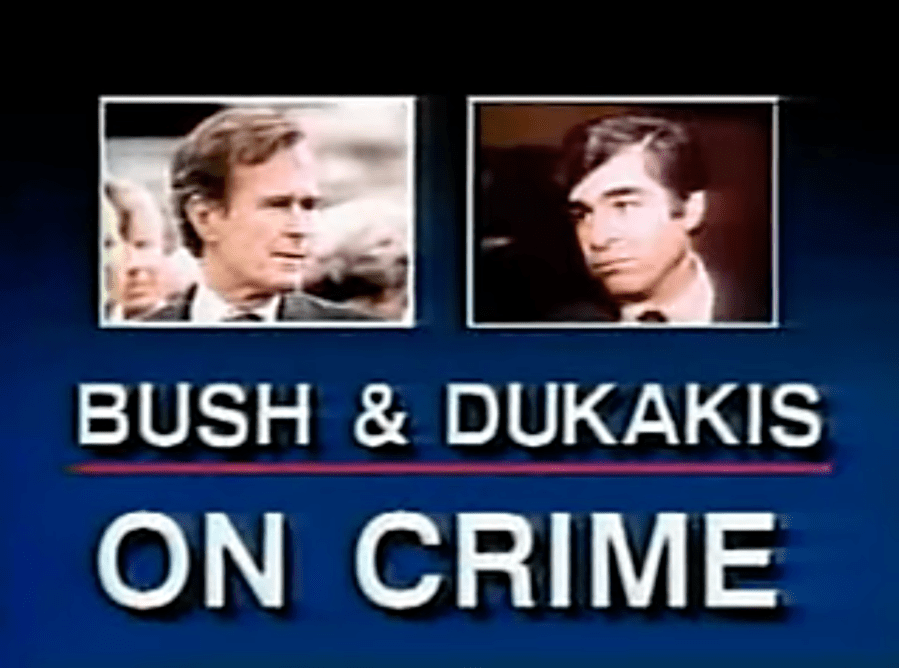
Perhaps the most widely-discussed, and generally-accepted, take on the politics of punishment is the infamous “Willie Horton Effect.” Named after the “star” of a controversial 1988 Presidential campaign ad aimed at Michael Dukakis, the Democratic nominee, the intuition behind the claim is straight-forward: it is always politically safer to be tougher on crime, because one bad outcome from being “too” lenient is far more politically costly than being “too” harsh hundreds of times.
The story here is pretty simple. Prior to the 1990s, almost every state and the federal government had a furlough program–a program that would allow people serving time in prison, even those convicted of serious offenses, to return home for brief weekend stays, in order to maintain ties to their community, if only to facilitate later reentry. Massachusetts had such a program, and while Dukakis had only inherited it when he became governor, he did sign off on its reauthorization. While Dukakis was governor, William Horton was serving time for murder, but he still qualified for furloughs. On one such furlough, he ran off to Maryland, broke into a couple’s home, and viciously attacked the man and brutally raped the woman. He is still serving a life sentence in prison in Maryland for the crimes.
In 1988, a group associated with the George HW Bush campaign, led by Lee Atwater, produced an ad that used Horton’s story to attack Dukakis for being “soft on crime.” You can see the ad here. (A depressing side note: at the time, it was considered a profoundly racist ad–two years later, on his deathbed in 1990, Atwater apologized for the Horton campaign. So it is somewhat terrifying to realize that by the standards of Republican ads in the 2020s, its racism is mild, almost quaint.) For a long time, the ad was seen as playing a real role in helping Bush defeat Dukakis in the 1988 election.
The thing about the Horton story is that we knew at the time that such events were vanishingly rare, that the ad was capitalizing on a shocking, non-representative anecdote. For example, in a contemporaneous article in the Christian Science Monitor, published shortly before the election in September 1988, criminologist James Allen Fox noted that over 99% of those furloughed returned without incident. Horton was an outlier. But his case got all the attention.
And by the time the dust settled from the 1988 election, every state and the Feds had ended their furlough programs. They basically do not exist anymore, surely in part because of the story that attached itself to one ad. And thus was born the “Willie Horton Effect”: it doesn’t matter if a program has an almost-100% success rate, because it’s impossible to get to exactly 100%, and cynical politicians can effectively exploit the one inevitable bad failure. No political benefit, all political risk, so why bother.
It’s clear that politicians believe in this effect. During the 2017 Brooklyn DA race, when Eric Gonzalez faced a strongly contested primary, I recall seeing him stand up in a debate and expressly invoke it, albeit not by name, when he told the audience that he was in favor of bail reform, but they had to promise him that they wouldn’t turn on him if one case went south.
Academics believe in it too. I myself have written pieces arguing that it is one of the single biggest impediments to criminal legal reform. But over the past few years, my attitude has shifted. I don’t think it’s irrelevant, but I think politicians tend to oversell its significance, and I think it is worth thinking a bit about why.
Why (We Think) The Effect Exists
The Wille Horton Effect isn’t unique to the criminal legal system. It’s just the term that crim law types have given to the far more ubiquitous problem posed by salience.
The idea of salience is this: things that are rare and shocking get people’s attention, and because of that attention they shape the actions taken by politicians and regulators. Quite often these are not the threats that really pose serious risks–that’s right there in the “rare” part of the definition–but they are the ones policy-makers have to respond to. I’d argue that the issue of salience in general is one of the single biggest threats to sound policy, if not the biggest threat, across all areas of policy.
In this context, it’s not just salience, but an asymmetric salience. Whenever someone (a judge, a prosecutor, a parole board member, whoever) sets a sentence, there are two types of errors they can make: the false positive (thinking “he’s dangerous!” more than he is and thus locking someone up too long) and the false negative (thinking “he’s not that big a risk” incorrectly and letting someone out too soon). The problem is that only one of these is observable. We can “see” the false negative, because the whole way we know we let someone out too soon is that they commit another crime.1 Opponents of the release can then hype up the salacious details of the new offense.
But how do we “see” the false positive? How do we show the counterfactual, that had we let this guy out earlier, he wouldn’t have committed another crime? There’s no concrete story to hype up here. We can show it statistically–“according to Table 4A, people in Risk Pool A only commit new violent crimes 3% of the time, so since Bob was in Pool A, he….”–but Table 4A never stands a political chance against injured victims or grieving families. And it’s impossible to challenge the accuracy that the victim was victimized, but people can always challenge the methodology for determining who is in Risk Pool A or what their actual reoffense rates are, or what an acceptable level of risk is in the first place.
The politics of salience, in other words, is deeply asymmetric. And leans in favor of “why take risks? just be harsh.”2 It’s unsurprising that elected criminal-legal actors (or the at-will appointees of elected officials) feel pulled in the direction of severity.
Two things, however, have made me rethink the inevitable of the Horton Effect: I think of them as the Huckabee Effect and the Browder Effect.
The Huckabee Effect: Sometimes No One Seems to Care
One of the less appreciated changes in penal policy over the past century has been the near-total collapse of gubernatorial clemency. In the late 1800s and early 1900s, governors used to pardon and commute sentences in volumes that are almost inconceivable today.3 One exception to this pattern was Arkansas’s Mike Huckabee, who during his decade as governor commuted or pardoned over one thousand sentences, more than several of his predecessors combined. And several of the people whose sentences he commuted went on to commit Horton-like crimes. In one case, a high-risk person whose release he approved murdered four police officers in Washington State sitting in a coffee shop in cold blood, and in another a man convicted of rape was released early and was shortly thereafter rearrested for another rape.
Yet while these controversial commutations (along with others that seemed to benefit friends and political allies) have received some media attention, they do not seem to have derailed Huckabee’s political career. It’s true that his Presidential achievements have fallen well short of his Presidential aspirations, but I don’t recall ever seeing these events being part of the narrative that thwarted his campaigns. Perhaps if he had done better and lasted longer, opponents eventually would have brought them up, but for whatever reason they were not raised immediately.
Which is to say: pointing to the Willie Horton ad and saying “see, we can’t risk a failure” is another example of selecting on the dependent variable. It’s true that many attack ads will draw on rare, one-off bad events, but that does not mean that every rare, one-off bad event will end up being politically costly. Only some–maybe only a few, maybe next-to-none–will, which means that politicians may have a lot more room to take risks than the Willie Horton narrative suggests.
In fact, political scientists now think that the Willie Horton ad itself did not actually move the needle.4 If anything, the real “Willie Horton Effect” is that politicians fear a negative political hit, not that such a negative political hit will happen. The fear is real, and it has real effects on behavior. But we lack little if any empirical evidence about just how real the effect is, and certainly some anecdotal evidence indicating that is does not always happen.
The Kalief Browder Effect
The other pushback to the Horton Effect that I’ve been thinking about is that the salience issue may not be as asymmetric as I used to think, at least not in the communities where crime and victimization are most densely concentrated.
Think back to my example above, that the only way to identify the false positive–the person who held too long–is via statistics, since we can’t directly observe how they would have acted had they been released sooner. This is true … only if I don’t actually know the person in question. But if I do–if that person in prison was my son or cousin or neighbor or friend–then I might actually know that, if released earlier, he almost certainly wouldn’t do anything bad.
So in higher-crime communities, the false positive can be directly felt, and can be quite salient, when the person is a family member now (excessively) suffering behind bars in someplace like Rikers or Clinton–the misery of which is also far more salient in communities that have high levels of exposure to incarceration. Like Kalief Browder, whose three years as a teenager locked up on Rikers for allegedly stealing a backpack led to such emotional harms that he died by suicide shortly after his release when the charges were dropped. To his family, Browder wasn’t an abstraction or a line on a spreadsheet, but a real three-dimensional person with goals and aspirations that they knew. Their community knew that his confinement was excessive, and they felt the harm directly–in this case, death by suicide, but in all cases the lingering traumas that come from incarceration or punishment.
Which suggests that the Horton Effect may be less prevalent in higher-crime communities, for whom both types of error costs are salient and relevant. Which in turn could explain why higher-crime communities, and Black neighborhoods more broadly, often maintain their support for reform prosecutors even as crime rates rise or scandals occur.5 It also may explain why these communities appear to “split” their vote between less-reform-minded mayors (who shape policing) and more-reform-minded prosecutors (who shape punishment and confinement): they want the police to prevent the crime (because they feel the costs of under-enforcement), but they don’t want tough-on-crime prosecutors who overpunish (because they feel those costs too).
In other words, the Horton Effect may be as much as “Non-Exposure” Effect as anything else. The more those who are removed from crime have a say in crime control policy, the more the politics of punishment are vulnerable to Horton-like campaigns. The more we give control of crime policy to impacted communities, then, the less we need to worry about salience-driven policy, since the realities of crime and punishment are far more lived experiences.
Conclusion, and a Surprising Reason for Hope
My point here is not that the Horton Effect is false. I have no doubt that bad cases have shaped elections, and will do so again in the future.6 But I think that we have allowed an emotionally-compelling anecdote to rise to the level of some sort of Political Truth, when the empirical reality is far more complex. And I think it is essential to pay attention to where we think the risk is greatest. This is one reason why I push so much for local autonomy and against state-level preemption, because the communities that experience crime the most are the ones least vulnerable to sort of salience-driven bad policies that the Horton Effect creates.
I want to end with a strangely hopeful counter-example. Horton was not the first person on furlough to commit a crime while released. Several years before, in California, two people out on furlough each committed a murder. One murdered a police officer. And while law enforcement officials called for the furlough program to be abolished, the governor stubbornly defended it. Expressly rejecting Horton Effect-like logic, the governor said that California was “leading the nation in rehabilitation,” that “More than 20,000 already have these passes, and this was the only case of this kind, the only murder,” and most importantly that “Obviously you can’t be perfect.”
That governor? Noted California progressive … Ronald Reagan.
We do not have to be as reflexively punitive as we are. In some ways, it’s depressing to think that Democratic governors today are to the right of Ronald Reagan on crime. In other ways, it shows that the current levels of political fear are not inevitable.
.
- So, yes, this is a bit of an oversimplifcation of things, given that prison itself can increase the risk of future offending, so perhaps the crime that happens is due to the (shorter) sentence not being short enough, and had we let the person out even sooner he would have been less likely to commit a crime. This is how we should really think about the problem, if we’re crafting some sort of fully-comprehensive set of policy recommendations. But for the purposes of working through the politics of the Horton Effect, that is not how the general public (currently) perceives things. ↩︎
- These incentives are further magnified by various other cracks and imperfections that run through the criminal legal system. For example, not only is it often politically safer for a prosecutor to seek a longer sentence, but by seeking out a felony conviction rather than a misdemeanor one–by seeking a longer prison sentence rather than a shorter stay in jail or on probation–the prosecutor also offshores all the fiscal costs. State governments pay for prisons, while county governments pay for jails and often probation. Prosecutors are also mostly funded by the county, so tougher sentences are politically expedient and move the costs of punishment to a different jurisdiction’s budget. ↩︎
- Back in graduate school, when I was reading Gem of the Prairie: An Informal History of the Chicago Underworld by Herbert Asbury (whose Gangs of New York is far more famous), I was stunned by just how often the governor of Illinois seemed to commute the sentences of clearly dangerous people. And not seemingly due to the usual story of Illinois corruption, but in a much more routine-seeming way. ↩︎
- Bush was an incumbent, the economy was good, and Dukakis was short. It was always a long-shot campaign. ↩︎
- I haven’t written about this here yet (although I will shortly), but it’s worth noting that between the 2016 and 2020 elections in Cook County (Chicago), Cook’s reform prosecutor, Kim Foxx, saw a meaningful drop in support across almost all majority-white precincts, but flat or rising support in majority-Black precincts (both the higher-violence ones in the city itself and the safer majority-Black southern suburbs in Cook), despite all the media attention given to the Jussie Smollett case. ↩︎
- In fact, I’ve long wondered if Kim Foxx would have defeated Anita Alvarez without the Laquan McDonald case completely backfiring on Alvarez. In many ways, the McDonald shooting was something of a Horton Effect, albeit one more of Alvarez’s own doing (since the political blow was far more the coverup than the shooting itself). ↩︎
 Prisons, Prosecutors, and the Politics of Punishment
This reminds me of my noting that people in Iowa and New Hampshire seem to be a lot more worked up over the “border crisis” than people in Texas, who live near the border and largely see it as a nothing burger. Direct or near-direct experience vs. only hearing a carefully crafted story.
LikeLike
Pingback: Changing the Narrative: Media’s Role in Perpetuating Stereotypes – Justice Unshackled
Pingback: Justice Unshackled | Episode 9 | Changing the Narrative: Media’s Role in Perpetuating Stereotypes – Justice Unshackled